Below the Ice — Teaching Robots to Daydream
Hugging Face lanzó LeRobot v0.6.0 con un paradigma de entrenamiento llamado Imagina, Evalúa, Mejora. Esta noche vamos más allá del número de versión — qué significa que un robot imagine, cómo un modelo de mundo aprendido le permite ensayar futuros antes de tocar el hardware, y por qué este bucle es una de las ideas más prometedoras en la IA encarnada hoy.
This is the print twin of tonight's Below the Ice — our evening deep-dive, one topic told properly. Prefer it in your ears while you wind down? Listen to today's episode.
The headline today is "Hugging Face releases LeRobot v0.6.0." That's accurate, and you could skim the release notes and move on. But buried inside the release is a phrase worth sitting with: Imagine, Evaluate, Improve. It's not marketing copy. It is a technical architecture — and it describes something that is genuinely changing how robots learn. Tonight we go below the version bump.
What it is
LeRobot is Hugging Face's open-source robotics framework — a library for training and deploying robot policies using machine learning. Before LeRobot, the kind of robot learning that could produce a manipulator arm that reliably picks up objects was largely confined to well-funded research labs with entire teams dedicated to it. LeRobot's goal is to make that work accessible to any team with a GPU and a decent amount of time.
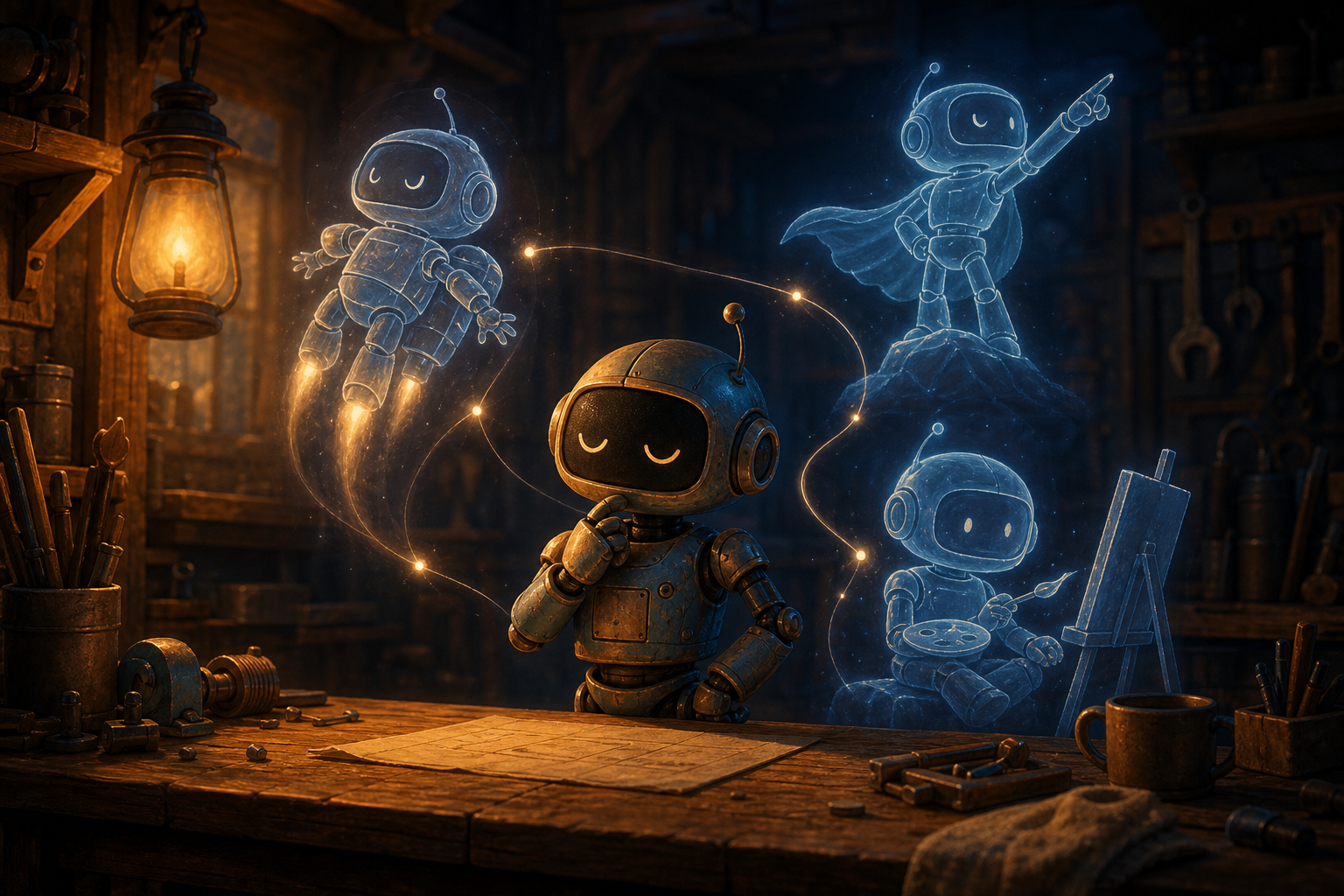
Version 0.6.0 introduced a new training paradigm. The core idea: before a robot acts in the physical world, it should think. It should run its possible actions forward through a model of how the world responds, evaluate the results of those imagined actions, and use what it finds to improve its policy — all without moving a single servo. The loop is called Imagine, Evaluate, Improve, and it is a practical implementation of what machine learning researchers call model-based reinforcement learning.
How it actually works
The chess player analogy is the right one. Before a strong chess player moves a piece, they don't just pick the first move that feels good. They mentally trace a sequence: "If I move the knight here, they'll likely respond there, then I can play this, and three moves down I'll have a better position." The player is running a simulation inside their head — a simplified model of the board's future — and evaluating outcomes before committing to a single physical move.
A robot trained with LeRobot v0.6.0 does something structurally similar, in three phases:
Imagine. The robot uses a world model — a neural network trained to predict what the world will look like after a given action is taken. Given the current sensor state ("I see the cup is 12 cm to the left, slightly tilted"), the world model predicts the next state for each candidate action ("if I move my arm 3 cm forward and close the gripper, the cup will likely be in my grip"). The robot runs many of these forward passes, generating a fan of imagined futures.
Evaluate. Each imagined rollout is scored by a reward function — a signal that encodes what "success" looks like. Did the imagined future result in the object being picked up? Was the path efficient? Did the robot avoid a joint limit? The reward turns each imagined trajectory into a number.
Improve. The best-scoring imagined trajectories get used to update the robot's policy — the neural network that decides what action to take next. Instead of waiting for a real robot arm to fail or succeed in the physical world, the feedback loop runs inside the world model, which is much faster and cheaper. The physical environment is consulted to keep the world model honest, but the bulk of the learning happens in simulation.
The key insight is that the bottleneck in robot learning has never been compute — it has been physical interaction time. Real hardware is slow. Joints wear out. Objects fall. Each trial takes seconds or minutes in the real world and milliseconds in simulation. If you can build a world model accurate enough to make imagined rollouts trustworthy, you get a dramatic multiplier on how much learning you can squeeze from each real-world episode.
Why it matters now
Robot learning has lagged language and vision AI by years, and the gap mostly comes down to data. Language models train on billions of web pages. Vision models train on billions of images. Robots have to collect their data by physically doing things in the physical world, and that is inherently slow and expensive. You can't just scrape YouTube for a training dataset that teaches a robot to fold laundry — the actions, the physics, and the outcomes are all invisible to a camera-only stream.
Model-based RL is one of the most credible answers to this problem. If a good world model lets you run a thousand imagined rehearsals for the cost of one physical trial, you've effectively multiplied your data budget a thousandfold. That changes what's feasible to train — tasks that would require months of physical robot time become tractable in days.
What makes the LeRobot release meaningful is not the concept itself, which has been studied since the early work on Dyna-style architectures in the 1990s. It's the fact that a high-quality, open-source, well-maintained implementation is now freely available — integrated into the same library that already handles data collection, training pipelines, and hardware interfaces. A team that could previously get a basic imitation-learning robot working can now experiment with model-based RL without starting from scratch. That's the kind of tooling availability that historically unlocks a wave of applied research.
The broader context: embodied AI — AI that acts in the physical world, through robot arms, mobile platforms, and humanoid hardware — has become one of the frontier bets. NVIDIA has bet heavily on it with its Cosmos world foundation model platform. Google DeepMind has been publishing robotics research at a rapid pace. The underlying techniques — world models, model-based RL, visuomotor policies — are the same family of ideas. LeRobot v0.6.0 is the open-source version of the same bet, made accessible.
What is overhyped
The honest caveat, and it matters: a world model is not a map of reality. It's a compressed, learned prediction — and it drifts.
The imagined rollouts the robot generates are only as good as the world model's accuracy. World models trained on a limited set of physical interactions will have blind spots. They'll be confident in terrain they've seen and wrong in terrain they haven't. The further you ask the model to simulate into the future, the more the errors compound. A robot that's been trained to pick up a red cup will have a world model that is good at imagining red-cup futures and quietly wrong about everything outside that distribution.
The "hallucination" problem for language models has a close analogue here: a world model can generate fluent, confident imagined trajectories that describe impossible physics or predict outcomes that never happen in the real world. If the reward signal can't catch this — if the evaluation step is also operating on the world model's outputs rather than real sensor data — you can end up with a robot whose policy is beautifully optimized for a fantasy world that bears only a passing resemblance to the one it will actually operate in.
The fix is careful curation of when and how much to trust the imagination versus the world. That's an active research question, not a solved one. The DreamerV3 work from Danijar Hafner and colleagues is probably the most rigorous published treatment of how to make world models actually robust — and even there, the results are impressive within defined domains and more fragile than they appear when you push them outside training distribution.
LeRobot v0.6.0 makes the paradigm accessible. It doesn't make the fundamental hard problem disappear.
What to watch
Three concrete things, the way we close every dive.
-
Whether the world model generalizes beyond the training objects. The current LeRobot demos are impressive on the objects and environments they were trained on. The real test is whether the Imagine–Evaluate–Improve loop produces policies that transfer to new objects, new lighting, new surfaces — without a fresh round of real-world data collection. Watch the community's replication attempts over the next few months. That's where generalization either holds or cracks.
-
The collision with foundation world models. NVIDIA's Cosmos is trying to do something related at much larger scale — train a world model on massive video data that can serve as the backbone for many downstream robotics tasks. If that bet pays off, the "imagine" step in LeRobot's loop might eventually borrow from a large pre-trained world model rather than training one from scratch per task. Watch for Hugging Face and similar open projects to either integrate with or produce their own foundation-scale world model over the next year.
-
Whether open robotics data materializes. The bottleneck will shift. Once the training paradigm is solid, the constraint becomes the quality and diversity of the initial real-world data that seeds the world model. Language models had Common Crawl. Robotics doesn't have an equivalent yet — there's no internet of robot demonstrations. Open X-Embodiment and similar efforts are the embryo of that dataset. Watch whether the momentum around open robotics tooling (LeRobot, Lerobot datasets, Hugging Face's robot data collections) builds enough critical mass to create something comparable.
Tonight's version bump is a real one. The Imagine, Evaluate, Improve loop is not a gimmick — it's one of the most promising structural ideas in embodied AI, and having it in an accessible open framework matters. The hard problems remain hard. But the tools to attack them just got better.
That's tonight's Below the Ice. The full episode — same topic, out loud — is up now: listen to today's episode. More deep-dives at penguinalley.com.
Sources: LeRobot v0.6.0 release — Hugging Face blog · DreamerV3: Mastering Diverse Domains through World Models — Hafner et al. 2023 · NVIDIA Cosmos World Foundation Model Platform · Open X-Embodiment: Robotic Learning Datasets and RT-X Models