Cold Open — Codex Hits 7M. The Agentic CLI War Has a New Scoreboard.
OpenAI Codex alcanzó 7 millones de usuarios — 10× en 6 meses, +1M en un solo día — y la pregunta está en el aire: ¿ya superó a Claude Code? Además: Codex cifra los prompts de sub-agentes, y un builder solitario entrenó con RL un agente que entrena modelos por –$1,300.
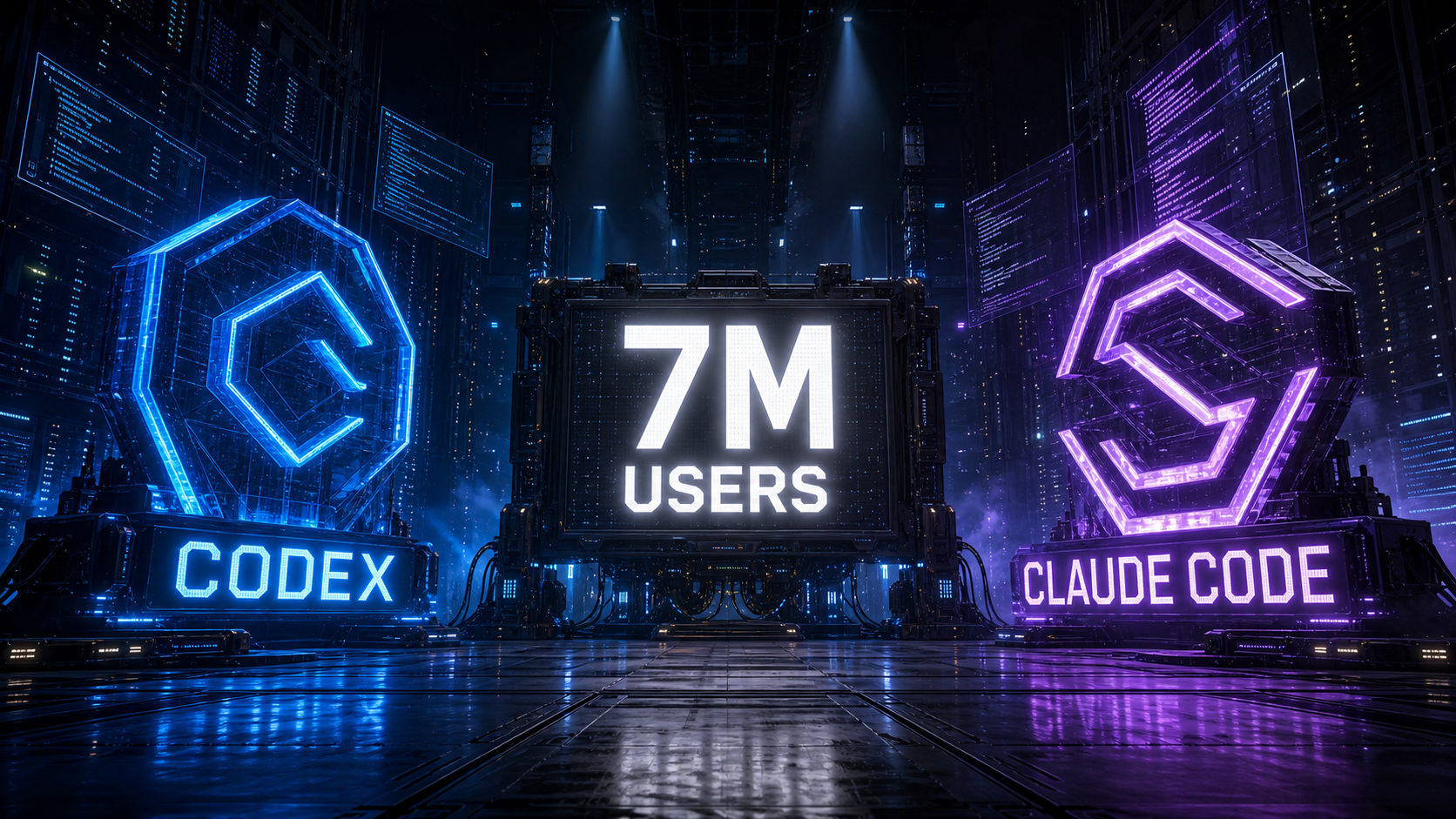
Monday, July 14, 2026. We scanned 738 items across 21 sources; three made the cut — and the lead is the number that rewrites the competitive picture for every builder choosing which coding agent to back.
Listen to today's episode on the Cold Open podcast page.
The lead · Codex hits 7M users — and added 1M in a single day

OpenAI's Codex just crossed 7 million users — a 10× increase in six months — and picked up one million new users in a single day. The Latent Space team tracked the numbers and put the question plainly in their Monday AINews digest: "did Codex overtake Claude Code??"
The one-day spike is the story inside the story. A single day adding 1M users to a developer tool is not organic growth — something triggered it: a product announcement, a pricing shift, a viral demo. The Latent Space piece does not name the catalyst, but the chart is clear.
"Codex usage up >10x in 6 months to 7M users, +1M in the past ~day; did Codex overtake Claude Code??" — Latent Space AINews, July 14 2026
Why it matters
If you are deciding right now which coding agent to build your workflow around, this number changes the framing. Claude Code has been the developer-first standard; Codex has been the API-layer product. A 7M-user mark and a single-day spike of that size signals the market is much larger and faster-moving than benchmark sheets suggest — and that Codex is not staying in the API lane.
Network effects in developer toolchains are real and compound. More users means faster feedback, faster iteration, and a faster ecosystem of plugins, extensions, and documented patterns growing around whichever agent is leading. This is not just a scoreboard update — it is a trajectory signal.
The fine print
These are usage counts, not DAUs or retention numbers. A user who signed up during a viral day and never returned still counts. And "overtook Claude Code" is an open question — Anthropic does not publish equivalent user counts for direct comparison. Hold the headline lightly, but hold the 10× in six months firmly. That part is structural, not a spike artifact.
Sources: latent.space — AINews July 14
02 · Codex starts encrypting sub-agent prompts

A GitHub issue in the public Codex repository surfaced a concrete security improvement this week: Codex now encrypts the prompts it passes to sub-agents. When a Codex session spins up a sub-agent, that agent's prompt carries context — project files, instructions, potentially sensitive business logic. Encrypting those at rest and in transit is a meaningful trust improvement for enterprise teams running Codex against private codebases.
Why it matters. Security on agentic coding tools has been an afterthought in most products — capability first, guardrails later. Seeing sub-agent prompt encryption surface as a tracked improvement in an open public issue means the security layer is moving from implicit to explicit. For teams evaluating coding agents against security policies, this is the kind of concrete, auditable change that actually moves procurement decisions.
Sources: github.com/openai/codex/issues/28058
03 · A builder RL-trained an agent to train models — for –$1,300

On Hacker News this week: "Show HN: I RL-trained an agent that trains models with RL (for –$1.3k)". The project, published by Danau5tin on GitHub as ai-trains-ai, is exactly what it says — a reinforcement learning agent whose job is to run the RL training loop on other models. Total cost: $1,300.
The premise: can a solo builder implement a useful autonomous model-improvement loop without frontier-lab budget or infrastructure? The demo says yes, at a cost comparable to a few cloud GPU hours and an experiment budget. The code is open source and the methodology is in the repository.
Why it matters. This is the Jevons paradox for builders. When the tools to train models become cheap enough that a weekend project can cover the cost, the constraint shifts from infrastructure to ideas. The $1.3k number is not just a price tag — it is a capability floor that keeps dropping. What required a research team two years ago fits in a GitHub repo today.
Sources: github.com/Danau5tin/ai-trains-ai
Also on the radar
- AI safety strategy — Demis Hassabis outlined his plan to harness AI safely in a new post. Worth reading for anyone tracking where safety thinking is landing at the frontier labs.
- CI/CD tooling — Simon Willison published a clean pattern for using uvx in GitHub Actions in a cache-friendly way — small improvement, real cumulative savings across large repos with Python tooling.
- DOOMQL — yes, someone ran DOOM inside a SQL query engine. No practical application. Extremely good energy.
- Quantum error correction — NVIDIA's Ising Decoding cuts color code logical error rates by over 300× on quantum hardware — a hardware-layer milestone on the long road to fault-tolerant quantum compute.
Trends in dev tools
What moved today in the tools engineers actually ship with.
- The CLI is becoming the terminal for AI agents. Codex's 7M-user surge happened entirely through a CLI and API interface — no IDE integration required. The developer tool market is reconfiguring around command-line interfaces as the primary agentic surface. If you're building tooling for AI workflows, the terminal is where your users are. Source: latent.space
- Sub-agent security is graduating from wishlist to changelog. Encrypted sub-agent prompts in Codex is a small surface area but a significant maturity signal. Agentic tools are starting to build security features you can point an auditor at. Source: github.com/openai/codex/issues/28058
- uvx in CI/CD is worth a look. Simon Willison's cache-friendly uvx pattern for GitHub Actions means you can pull Python tooling into CI without the usual dependency-lock headaches — useful anywhere you use uv for Python toolchain management. Source: simonwillison.net
- Dynamic Agent Skills are being formally taxonomized. A new arXiv survey (arXiv:2607.10113) maps how agent skill libraries evolve — creation, validation, composition, deprecation. The first formal attempt to turn "folder of instruction files" into a trackable discipline. Source: arxiv.org/abs/2607.10113
Popular skills
The agent-skills wave is getting academic attention and sharper practice.
- Agents need a "don't act" skill. AgentAbstain (arXiv:2607.10059) asks whether LLM agents know when not to act — and finds most current agents are overconfident about their own capability boundaries. The paper proposes evaluation protocols for abstention accuracy. Source: arxiv.org/abs/2607.10059
- Skills as self-discovered context. Agentic Context Learning with Self-Discovered Specification (arXiv:2607.09794) shows agents can discover and encode their own operating context as reusable specifications — a step toward skill libraries that write themselves from observed work. Source: arxiv.org/abs/2607.09794
- A lifecycle map for skill libraries. Dynamic Agent Skills: A Lifecycle Survey (arXiv:2607.10113) surveys how agent skill repositories evolve and proposes a shared taxonomy. The first formal map of a practice most agentic builders are already doing intuitively. Source: arxiv.org/abs/2607.10113
AI fun fact
The word "codex" is Latin for the trunk of a tree — specifically, a block of wood used as a writing surface. By the 4th century CE it had evolved to mean a bound manuscript book, and the shift from scroll (volumen) to codex was the biggest format change in information storage before Gutenberg. The codex made it possible to flip to any page instantly instead of unrolling to find content — the original random-access interface. Seventeen centuries later, OpenAI named their coding agent after the same word.
Source: Britannica — codex
Sources: latent.space — AINews July 14 · github.com/openai/codex/issues/28058 · github.com/Danau5tin/ai-trains-ai · twitter.com/demishassabis · simonwillison.net — uvx · simonwillison.net — DOOMQL · arxiv.org/abs/2607.10113 · arxiv.org/abs/2607.10059 · britannica.com/technology/codex-manuscript