Below the Ice — The Three-Second Theft: How AI Voice Cloning Outruns Every Defence
Bastan tres segundos de audio para clonar una voz lo suficientemente bien como para engañar al sistema de autenticación por voz de un banco. Esta noche vamos por debajo de ese titular: cómo logra esto la síntesis de voz moderna, por qué los sistemas de autenticación en los que confiábamos fueron diseñados para un mundo que ya no existe, y qué deben considerar los builders que trabajan con voice AI.
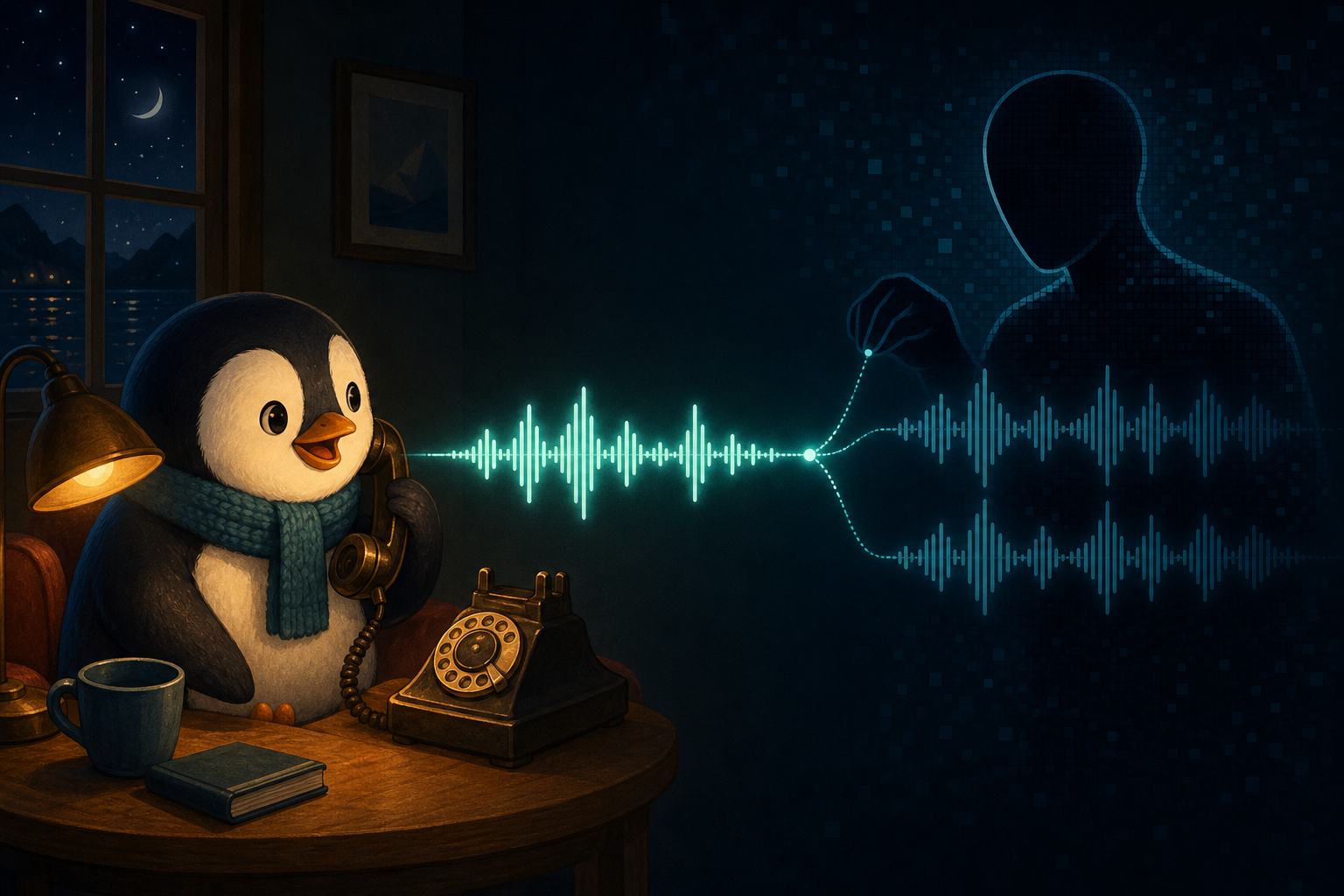
Listen to tonight's episode on Below the Ice.
Three seconds. That is the new minimum viable sample for a voice clone capable of fooling the interactive voice response system protecting your bank account. Not a recording studio. Not hours of training audio. Not a team of engineers. Three seconds of someone speaking — captured from a voicemail, a public video, a phone call — fed into a system that rebuilds their voice on the fly.
That is the headline from a piece that landed on Hacker News today with 52 points and active discussion. We go below it tonight. Because the story is not really about the crime. It is about a gap that opened quietly between what voice AI can now do and what the systems we trusted to keep us safe were designed for.
What it is
Voice cloning fraud is exactly what it sounds like: a bad actor captures a short audio sample of your voice, uses AI to generate new speech in that voice, and then impersonates you to a system — or a person — who expects to recognize you by sound.
The attack has existed in theory for years. What changed between 2023 and 2025 is the minimum sample requirement. Early commercial voice synthesis needed minutes or hours of training audio to produce a convincing clone. Systems like ElevenLabs' Instant Voice Cloning, launched in 2023, brought that floor to under a minute. By 2025, frontier voice models could produce convincing results from samples in the 10–30 second range.
The three-second threshold — cited in recent fraud intelligence reports — represents a qualitative shift. Three seconds is a greeting. A "hello, who's calling?" A voicemail introduction. It is audio that exists for nearly every person who has ever left a message, appeared in a social media video, or given a recorded interview. Which is, at this point, most people.
How it actually works
A voice is not a fingerprint in the way we intuitively imagine. It is a pattern — a distribution of frequencies, rhythms, prosody, and timbre that a speech synthesis model can learn to represent and reproduce.
Here is the mental model: think of your voice as a recipe, not a physical ingredient. Early voice synthesis had to collect the full recipe by watching you cook many meals — hearing you speak at length to extract the underlying patterns. Modern neural voice models take a fundamentally different approach. They have already learned the general grammar of human speech across thousands of speakers. When you hand them three seconds of audio, they are not learning your voice from scratch. They are locating it within a space of voices they already know.
Concretely, a modern voice clone pipeline runs roughly like this:
- Speaker embedding — the short audio sample is encoded into a mathematical vector representing where your voice sits in the model's learned space of possible voices.
- Text-to-speech synthesis — the model generates new speech from arbitrary text, conditioned on your speaker vector rather than a generic speaker profile.
- Vocoder rendering — the output mel spectrogram (a frequency-over-time representation of the audio signal) is converted to a waveform you can actually hear and transmit.
The whole pipeline runs in seconds on consumer hardware. The output is not flawless — artifacts remain, particularly on unusual phonemes and emotional extremes. But it does not need to be flawless to fool a voice authentication system running over a compressed phone line, where bandwidth and background noise already degrade the signal before any comparison happens.
Why it matters now
The fraud scenario that matters most is not someone calling your family. It is the industrialized, scaled version aimed at financial institutions and call centers — attackers running dozens of attempts an hour against voice biometric authentication systems protecting real accounts.
Voice biometrics — systems that check whether the voice on the call matches a stored voiceprint — became mainstream fraud-reduction infrastructure for banks and telcos in the mid-2010s. It seemed like a strong second factor: something uniquely tied to a person that an attacker could not easily replicate. By 2024, that assumption had quietly expired.
Two things changed simultaneously:
The attack became cheap. Running a voice clone pipeline requires a mid-range GPU and an afternoon of setup time. Several open-source toolkits — including maintained forks of Coqui TTS and frameworks like Kokoro — are freely available. The compute cost per fraud attempt is measured in cents.
The defense became static. A voiceprint, once enrolled, does not update. The institution captured a sample of your voice in 2019; it checks against that same sample in 2026. The attacker needs a sample recorded anytime across those seven years. The defense never improves once deployed; the attack capabilities improve with every model release.
The FTC, FBI, and major telcos have published advisories on AI voice fraud since 2024. What makes this a builder problem in 2026 is the proliferation of voice interfaces in products being shipped right now — customer service bots, phone-based multi-factor authentication flows, voice-first mobile apps — that are inheriting an authentication model built for a world before cheap cloning existed.
What is overhyped
The "three-second clone" number gets quoted as if the resulting audio is indistinguishable from the original. It is not — at least not in all conditions.
Human listeners, in quiet conditions with a direct comparison sample, can often detect modern clones. The artifacts are subtle but real: unnatural pitch transitions on certain phonemes, slightly mechanical rhythm, reduced dynamic range compared to a real speaker under emotional load.
The problem is that voice authentication systems are not careful human listeners with comparison samples. They are algorithms running on compressed phone audio, optimized for fast throughput, not for adversarial robustness. The clone does not need to fool a trained ear. It needs to pass a threshold in a system designed for a world without cheap cloning — and on that narrower challenge, it performs much better.
Liveness detection — the countermeasure that prompts speakers to say unpredictable words or respond to random challenges in real time — does meaningfully help and is harder to defeat than replaying a static sample. But it is not universally deployed, and generating a liveness-passing response from a live challenge via real-time text-to-speech is an arms race both sides are actively running.
What to watch
Three things worth tracking as this plays out over the next year:
1. Passive liveness detection becomes table stakes. The most promising near-term defense is not adding friction to authentication — it is analyzing the audio passively for synthesis artifacts that are difficult to suppress: noise floor signatures, codec mismatch patterns, unnatural subharmonic distributions. Several security vendors are shipping this layer in 2026. Expect it to become standard in voice-enabled financial products.
2. Regulatory pressure arrives first in finance and healthcare. The FTC has warned that AI voice fraud is an active consumer threat. The CFPB has opened inquiry into biometric authentication failures. If you are shipping voice-enabled products in regulated verticals, the risk is not just fraud loss — it is liability for deploying an authentication mechanism that regulators will flag as inadequate for the current threat environment.
3. The open-source clone floor will keep dropping. The same model capabilities driving commercial voice synthesis are available as open weights. Every new release that improves voice quality or reduces the minimum sample requirement also lowers the barrier for attackers. The gap between what the best defenders can deploy and what the worst attackers can run will not close on its own — it needs active investment in detection, not just authentication.
The real story under the three-second headline is architectural: we built voice authentication for a world where producing a convincing impersonation required substantial resources. That world ended quietly, and most of the systems built inside it are still running.
Sources:
- The Three-Second Theft: Why AI Voice Fraud Outruns Every Defence — the piece that surfaced today
- Hacker News discussion — 52 points, 33 comments
- ElevenLabs Instant Voice Cloning — the commercial benchmark for minimum sample requirements
- FTC Consumer Alert: AI cloning your family's voices — the regulatory framing on voice fraud