Below the Ice — The Mania Tax: How AI Hype Warps the Way Big Companies Decide
La manía de la IA no es solo ruido — está rompiendo activamente la forma en que las grandes organizaciones deciden. Esta noche desglosamos el mecanismo: cómo 'usa IA' se convierte en un mandato que cortocircuita la evaluación, por qué personas inteligentes quedan atrapadas en ella, y qué deben entender los constructores que entran en estos entornos.
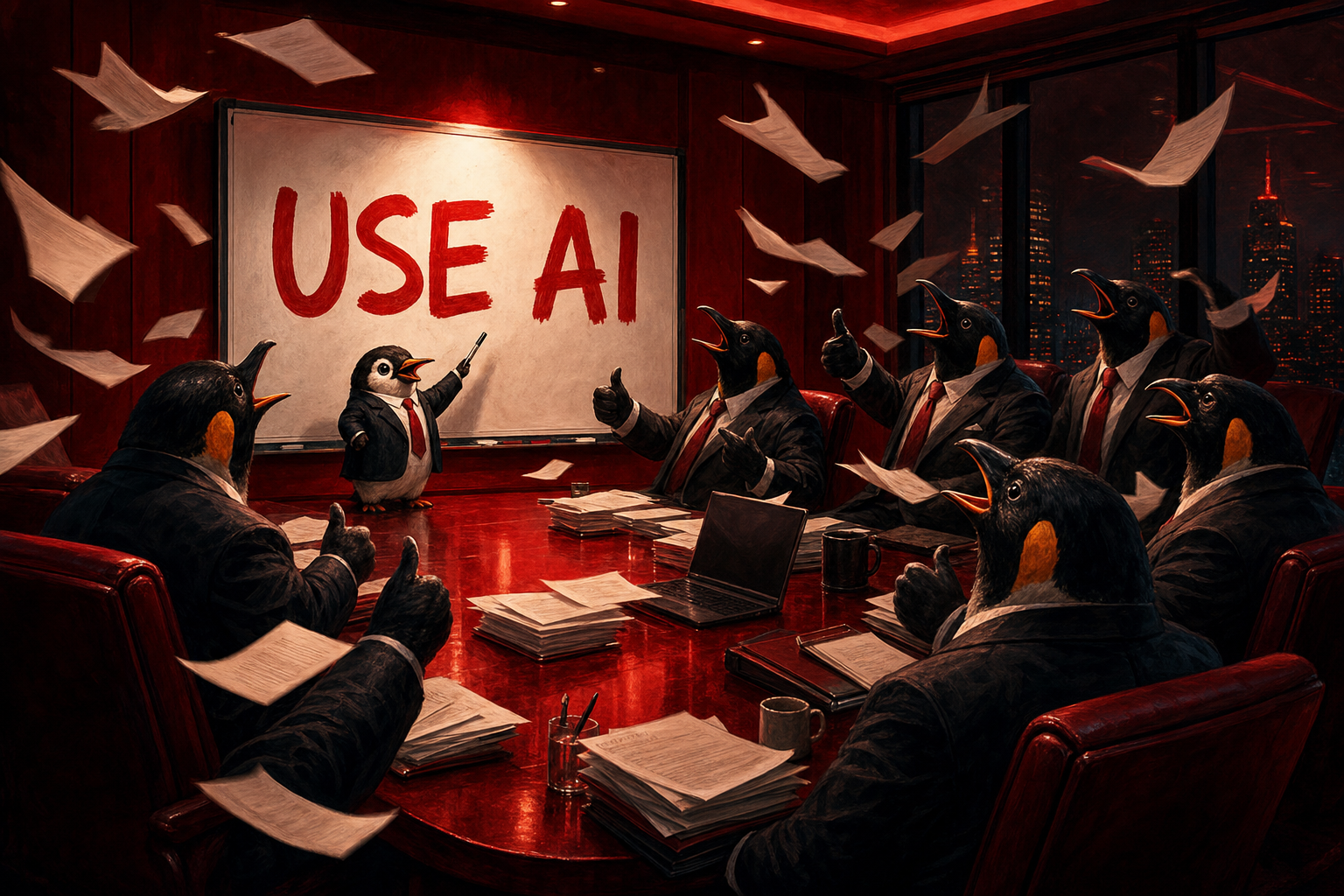
This is the print twin of tonight's Below the Ice — our evening deep-dive, one topic told properly. Prefer it in your ears while you wind down? Listen to today's episode.
The headline that stopped me today came from Nik Suresh, a consultant who spends his days inside large organizations watching them try to get serious about AI. His title: "AI Mania Is Eviscerating Global Decision-Making." It's spicy, intentionally so. But once you read past the headline, there's something colder underneath — not a polemic about AI, but a careful description of a specific social pathology. Something is happening in the rooms where big organizations make decisions, and it is worth understanding exactly what.
What it is
AI mania — in the organizational sense — is what happens when "using AI" shifts from being a judgment call to being a signal of status, seriousness, and forward-thinking leadership. The technology becomes a social fact before it becomes a technical one.
In practice it looks like this: a leadership team, pressured by boards, investors, or competitors, declares that AI is a strategic priority. That declaration creates a new organizational logic — one where the question is no longer "should we use AI for this?" but "how fast can we show that we are using AI?" The evaluation process does not disappear. It gets replaced. Rigorous cost-benefit analysis gives way to something closer to a visibility competition.
Suresh's essay is full of anonymized anecdotes from inside this dynamic: projects greenlit because they had "AI" in the title; expensive platform contracts signed under executive pressure without proper technical review; experienced engineers sidelined when their skepticism was read as resistance rather than diligence. The through-line is the same in every story — the social mandate for AI adoption colonizes the decision-making process, and then the decision-making process stops working.
How it actually works
The mechanism is easier to understand if you think about what good organizational decision-making requires. At a minimum: people with relevant expertise need to be able to say "this is risky" or "this doesn't work" without being penalized for it. The signal that carries the real information — the engineer's concern, the cost estimate that doesn't fit the narrative, the pilot result that was disappointing — needs to reach the people making the call.
Hype cycles break this mechanism in a specific way. They create what organizational researchers call an authority gradient reversal: normally, technical authority runs upward from the people closest to the work. In a hype cycle, the authority inverts — senior leaders or external consultants hold the narrative, and technical dissent from below gets reinterpreted as a status problem ("that team is resistant to change") rather than an information problem ("that team has data we should hear").
Think of it like the game of telephone, except the person at the start of the chain has quietly been replaced by a press release. By the time the message reaches a decision, it has traveled through layers of people who were incentivized to add optimism at each step. The mania tax is the cost you pay when that distorted signal drives real budget, real hiring, and real architectural decisions.
Simon Willison's writeup describes Suresh's essay as "crammed with spicy anecdotes" — and it is. But the mechanism behind the anecdotes is well-documented in organizational behavior research. It's the same dynamic that produced the dot-com overbuilding of 2000, the enterprise blockchain wave of 2018, and dozens of other technology-flavored rushes where the social fact of "we need this" outran the practical fact of "we know how to use it."
Why it matters now
The AI hype cycle is not like prior cycles in one important way: it is hitting a period when the technology is genuinely useful and genuinely changing. That makes the mania harder to name and harder to resist. With blockchain, the verdict was fairly easy to reach — the useful applications turned out to be narrow, and the hype collapsed under its own weight. With AI, especially LLMs, the applications are broad, the improvements are fast, and the tools are often genuinely good. The mania and the real signal are tangled together.
This creates a specific problem for builders. If you are building AI tools and selling them into enterprises, you will encounter organizations whose decision-making is already compromised. The project that hires you was greenlit under mania conditions. The stakeholders who signed off may not understand what they bought. The team that will use your work may have received promises from above that do not match what you are actually building.
The Gartner AI Hype Cycle already tracks this pattern: generative AI entered the Trough of Disillusionment for many enterprise applications by 2024, even as the underlying technology kept improving. The disillusionment is not about the technology failing — it is about the gap between the mania-inflated expectation and the real, more modest but durable value. When the gap is wide enough, even good tools get cancelled.
For builders who care about whether their work actually lands, that gap is the job. You are not just shipping code. You are entering a social situation that was shaped before you arrived, and the quality of your outcome depends on understanding that situation.
What is overhyped
The easy read of Suresh's essay is: enterprises are bad at technology and always have been. That is both true and misleading. Large organizations have always struggled with technology adoption — the friction is real, the bureaucracy is real, the incentive misalignments are real. But that is a baseline condition, not the interesting part of what is happening now.
The interesting part is the specific mechanism of mania, which is different from ordinary enterprise technology sluggishness. Ordinary sluggishness is friction — things move slowly, bureaucracy adds delay. Mania is inversion — it actually makes things move faster while simultaneously degrading the quality of the decisions being made. You get more activity and worse outcomes, which is a strange combination and one that is harder to diagnose from inside the system.
It is also overhyped to conclude that the individuals inside these systems are foolish. Suresh is clear on this: the people he observes are often smart and experienced. They are responding rationally to the incentive structure they are inside. When the signal for advancement is "shows urgency about AI," then urgency about AI is what you produce. The mania is systemic, not personal — which is actually the harder problem, because there is no villain to remove.
What to watch
Three things are worth following as this plays out.
1. The arrival of outcome accountability. The mania window opens before results can be measured. It closes when the first cohort of projects reaches the accountability point — when someone asks, what did we get for this? Watch for the organizations that can answer that question clearly. They will be the ones that managed to hold onto evaluation discipline during the hype, and they will have a durable advantage when the window closes.
2. The rise of AI governance as a corrective. Suresh's framing implies the need for structures that protect technical evaluation from social override — something closer to what we have for financial decisions, applied to AI adoption. The EU AI Act's requirements for high-risk AI systems are one forcing function. Internal AI review boards and mandatory pilot gates are another. Whether these become standard practice or compliance theater is the question.
3. Whether builders develop a mania-hygiene practice. The consultants and builders who will do well in this environment are those who develop a reliable way to assess the decision-making health of an organization before committing to a build — not because they can fix the mania, but because they can calibrate what success is actually possible given the conditions, and price and scope accordingly. That skill does not exist yet as a named practice. It probably will within a few years.
Tonight's story is about organizations, not models. But it is worth sitting with, because the environment where AI tools land shapes what they can accomplish as much as the tools themselves do. Building something good and watching it fail because the organization buying it could not make sound decisions — that is a recognizable kind of frustration, and understanding where it comes from is the first step toward doing something about it.
That's tonight's Below the Ice. The full episode — same topic, slower and out loud — is up now: listen to today's episode. More deep-dives at penguinalley.com.
Sources: AI Mania Is Eviscerating Global Decision-Making — Nik Suresh · Simon Willison's coverage and commentary · What's New in AI from the 2024 Gartner Hype Cycle · EU AI Act — European Commission