Cold Open — Cloudflare Rewrites the Bot Rules
Cloudflare declara el 'Día de Independencia del Contenido' con nuevos controles de tráfico IA para todos los clientes — los bots de entrenamiento serán bloqueados por defecto en páginas con anuncios a partir del 15 de septiembre. Además: un LLM de 28.9M de parámetros en un chip de $8, y Debian vota su política de uso de LLMs.

Sunday, July 26, 2026. We scanned 6 items off the wire this morning — source errors took out several feeds, but what came through is substantial. Three made the cut. The lead is Cloudflare drawing a hard line on AI bot traffic.
The lead · Cloudflare declares Content Independence Day

Cloudflare published "Content Independence Day," a major policy and product announcement giving every customer — free tier included — granular control over which AI bots can access their sites. The company is categorizing crawlers into three buckets: Training (bots scraping content to train AI models), Agent (AI assistants fetching real-time content to answer queries), and Search (traditional search indexing). Starting September 15, 2026, all new domains onboarding to Cloudflare will have Training and Agent bots blocked by default on pages that serve ads, while Search bots remain allowed.
The rationale is direct: an ad is a signal that the site owner intended human eyeballs. On those pages, Cloudflare is treating Training and Agent crawlers as taking value without returning attention.
Why it matters
This is a structural shift in how the web's plumbing handles AI traffic. Cloudflare sits in front of a significant share of global web traffic. When they move a default, the web moves with them.
For builders, the immediate practical change is the "Verified" bot reclassification. Previously, a Verified bot was allowed by default. That changes today. Now Verified means allowable within its category — a Verified Training bot is still blocked if you've set Training to block. More importantly: Googlebot, Applebot, and BingBot are multi-purpose crawlers that combine Search with Training behavior. Under the new rules, customers who block Training will block all three unless they manually opt out.
There's also a new use signal in robots.txt, extending the Content Signals framework:
User-agent: *
Content-Signal: search=yes,ai-train=no,use=reference
Allow: /
The use field has three levels: immediate (interact but store and reuse nothing), reference (default — index, excerpt, link back), and full (summarize and reproduce). Publishers can now express nuanced permissions without managing individual bots. Cloudflare will begin managing this signal in robots.txt for all sites using their content protection settings.
BotBase, a new Enterprise feature, surfaces every known bot's classification, category, and traffic history in the Cloudflare dashboard — the visibility layer that has been missing for years.
The fine print
Cloudflare's new defaults favor publishers, which also happens to favor their enterprise media customer base. Blocking Training bots on ad-serving pages by default aligns Cloudflare's commercial interests with publishers' interests neatly. Whether this meaningfully changes the economics of AI training data acquisition is a longer story. The signal is clear though: the web's infrastructure layer is starting to make AI content consumption a first-class access-control concern.
Sources: Cloudflare Blog — Content Independence Day: new AI traffic options
02 · A 28.9M parameter LLM on an $8 microcontroller
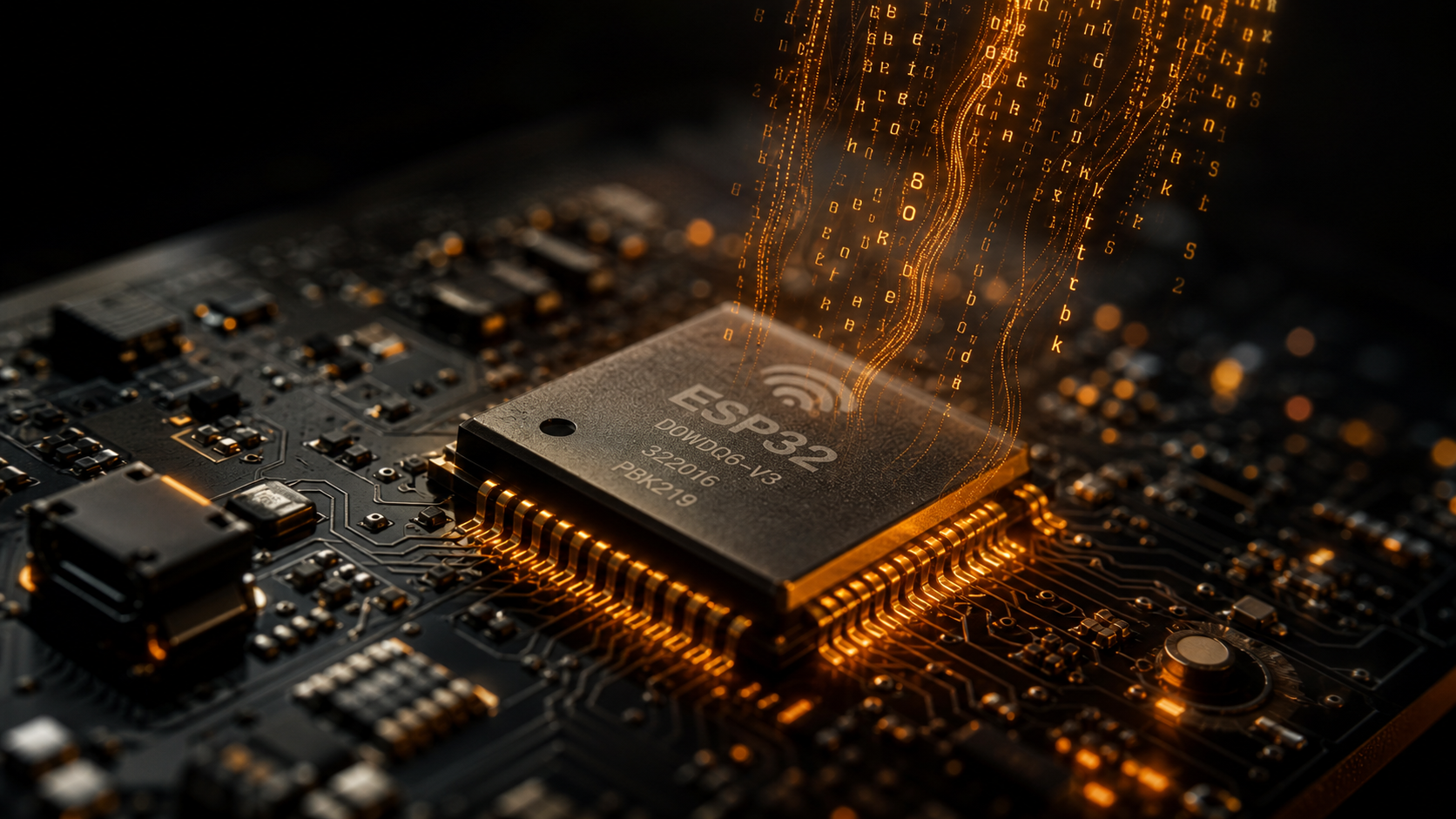
Developer slvDev has published a project running a 28.9M parameter language model on an ESP32-S3 — a microcontroller that costs about $8. It generates text at roughly 9 tokens per second, displays output on a small screen wired to the chip, and sends nothing to a server. The previous state of the art for this chip was a 260,000-parameter model. This one holds about 110 times more.
The trick is Google's Per-Layer Embeddings technique, from the Gemma 3n and Gemma 4 model families. Most of a language model's parameters live in an embedding table, which the model reads from but doesn't compute over. By leaving that 25M-row embedding table in the chip's slow flash memory and only loading the ~450 bytes needed per token (about 6 rows per generation step), the model never needs to fit the embedding table into the ESP32-S3's 512KB of SRAM. The compute core stays in fast memory; the large lookup table lives in flash and gets sampled a few rows at a time.
Why it matters. The meaningful barrier to on-device AI inference has been the embedding table problem. This project demonstrates that Google's solution for phones works at the $8 hardware tier. Every IoT device, embedded sensor, and offline instrument is now a plausible AI inference target. The privacy case for local inference becomes easy to make when the hardware is this cheap.
Source: GitHub — slvDev/esp32-ai: Running a 28.9M parameter LLM on an $8 microcontroller
03 · Debian votes on LLM usage — four competing proposals

The Debian project — one of the oldest and most influential Linux distributions — is holding a General Resolution vote with at least four competing proposals on LLM usage within the project. The proposals (A through D) were formally seconded by Debian developers and submitted to a project-wide vote. The winning proposal will govern how Debian contributors may use LLM-generated content in packages, code, and documentation.
Why it matters. Debian is the upstream of Ubuntu, and its governance decisions ripple across hundreds of derivative distributions. A formal resolution here sets a precedent for how large open-source projects handle AI-generated contributions — with enough vote weight behind it to become a reference policy for other communities. The fact that there are four competing proposals rather than a binary vote suggests the community is searching for nuanced middle ground: not a blanket ban, not unconstrained use, but something governance-shaped.
Source: Debian.org — General Resolution: LLM usage in Debian
Also on the radar
- Ruff v0.16.0. Astral released Ruff 0.16.0 — another update to the Rust-based Python linter and formatter that has been consolidating flake8, black, and isort into a single tool. Simon Willison covered it.
- Stanford on AI and jobs. The Stanford Institute for Economic Policy Research published a brief titled "What is happening to jobs? Separating AI hype from reality" — evidence-based framing for the workforce displacement conversation that's worth having before citing the headlines.
- UChicago Law School rewrites AI curriculum. The University of Chicago Law School published its AI strategy statement, requiring explicit per-course AI policies in every syllabus and securing access for students and faculty to AI tools used by leading firms. One of the more concrete institutional AI governance statements from a top-tier law program.
Trends in dev tools
What moved today in the tools builders actually ship with.
- Cloudflare's
usesignal in robots.txt. The newuse=reference|immediate|fullContent Signals extension gives publishers a machine-readable way to specify how content may be used, not just who may crawl it. Expect this to propagate into SEO and content tooling quickly — it's a standard that now has Cloudflare's enforcement layer behind it. Cloudflare Blog - Ruff v0.16.0. Astral shipped another Ruff release. If your CI still runs separate flake8 + black + isort steps, this is the moment to consolidate. Ruff is now the practical default for new Python projects at most shops. Astral blog
- Per-Layer Embeddings for edge AI. The technique validated by the esp32-ai project — keeping embedding tables in flash and sampling rows per token — is a deployment pattern now proven at the $8 hardware tier. If you're building offline AI features for embedded or IoT contexts, this is the architecture reference to study. slvDev/esp32-ai
Popular skills
What's gaining traction in the agent-skills wave this week.
- Bot category awareness for AI agents. Cloudflare's Training/Agent/Search taxonomy is now how the web's largest CDN classifies outbound crawler requests. If you're building web research or scraping agents, your crawler's User-Agent and behavior determine how it's classified in BotBase — and whether it gets blocked by September 15 defaults. Understanding the classification rules is table stakes for agent builders reaching the public web. Cloudflare BotBase docs
- Per-Layer Embeddings as an inference architecture skill. The esp32-ai README is an unusually clear writeup of the memory layout reasoning behind PLE — why embedding tables can live in slow storage, how per-token sampling works, and what the SRAM budget looks like. The pattern applies to any memory-constrained deployment, not just microcontrollers. slvDev/esp32-ai
- robots.txt as agent policy. The new Content Signals
useparameter gives agents a machine-readable signal about how a site's owner wants content used. An agent that respectsuse=referencevsuse=fulldistinctions is more likely to stay compliant with evolving platform policies — and now more likely to get through Cloudflare's enforcement layer. Content Signals spec
AI fun fact
The ESP32-S3 has 512KB of SRAM. The 28.9M parameter LLM running on it accesses roughly 450 bytes of its embedding table per token — that's about 6 rows out of 25 million. The model generates text by reading the world's smallest slice of its own knowledge on each forward pass, then discarding it. The entire embedding table would need roughly 100MB of fast memory if it loaded wholesale; instead it stays in flash and gets sampled six rows at a time.
Source: slvDev/esp32-ai — Why it is hard, and how it fits anyway
This is the print twin of today's Cold Open episode. Listen on The Penguin Alley.
Sources:
- Cloudflare Blog — Content Independence Day: new AI traffic options for all customers
- GitHub — slvDev/esp32-ai: Running a 28.9M parameter LLM on an $8 microcontroller
- Debian.org — General Resolution: LLM usage in Debian
- Astral blog — Ruff v0.16.0
- Simon Willison — Ruff v0.16.0
- University of Chicago Law School — Rethinking Legal Education in the AI Era