Cold Open — OpenAI's Daybreak turns Codex loose on the world's vulnerabilities
OpenAI launches Daybreak — Codex Security, a GPT-5.5-Cyber model, and a 'Patch the Planet' initiative — pitching AI that finds, validates, and fixes software vulnerabilities at scale. Plus NVIDIA's bid for trusted enterprise agents, Omio's AI-native rebuild, dev-tool trends, the agent-skills wave, and one fun fact about who really powers the world's fastest supercomputers.

Tuesday, June 23, 2026. We scanned more than 2,100 fresh items off the wire overnight. Three made the front page, a handful more made the radar, and one of them is OpenAI trying to secure the entire internet before your coffee cools.
🎧 This is the print twin of today's Cold Open episode. Listen to today's episode.
The lead · OpenAI's Daybreak: Codex Security, GPT-5.5-Cyber, and "Patch the Planet"

OpenAI introduced Daybreak, a set of tools built to help organizations find, validate, and patch software vulnerabilities at scale. The headline pieces are Codex Security — the security-focused turn of the same coding agent millions of developers already use — and a specialized model, GPT-5.5-Cyber. Alongside the product, OpenAI launched Patch the Planet, a Daybreak initiative aimed at open-source maintainers: use AI plus expert review to find, validate, and fix vulnerabilities in the open-source code the rest of the software world quietly depends on.
The framing is deliberately huge — "tools for securing every organization in the world." Strip the ambition back and the builder-relevant shift is concrete: security is being pulled into the coding-agent loop instead of bolted on after it. The same Codex that writes the diff is now being pitched to find the flaw in it and propose the fix.
Why it matters
For anyone shipping software, this collapses two steps that used to live far apart. Today, vulnerability scanning is usually a separate tool, a separate dashboard, and a separate team's backlog. Daybreak's pitch is that discovery, validation, and the patch can ride the same agent that already lives in your repo. That is genuinely useful — and it is exactly why the validation half of OpenAI's own wording matters. Both Daybreak and Patch the Planet pair automated discovery with a validation step, and Patch the Planet explicitly keeps expert humans in the loop. That is a quiet admission that "the AI found a bug" is a lead, not a verdict.
There is a bigger current underneath. The same day, Latent Space ran an interview with Gray Swan's Matt Fredrikson and OpenAI board member Zico Kolter arguing that AI security "is not just cybersecurity with AI" — it is becoming its own discipline. Daybreak is one frontier lab planting a flag in that ground and turning it into a product line.
The fine print
Three caveats before anyone re-tools their security program around it. First, this is a launch announcement: the capabilities are vendor-described, not independently benchmarked, and "at scale" patching of real-world code carries the obvious failure mode — an automated fix that is confidently wrong and merged anyway. The human-in-the-loop design is the mitigation, and it is worth watching whether it holds as volume grows. Second, a model branded for cyber is dual-use by nature; the capability that finds a vulnerability to fix it can find the same vulnerability for the wrong reasons. Third, "securing every organization in the world" is marketing, not a roadmap — read it as a direction of travel, not a delivered outcome.
Sources: openai.com/index/daybreak-securing-the-world · openai.com/index/patch-the-planet · latent.space
02 · NVIDIA wants enterprises to trust their agents, not just try them

NVIDIA published a piece arguing the first wave of enterprise AI was about access — companies ran pilots, tried frontier and open models, and explored what was possible. The next wave, it says, is specialized agents you can trust: systems built from open models, tools, skills, and a secure runtime, assembled through its Agent Toolkit so an agent fits the way a company's workflows actually run.
Why it matters. The enterprise question has shifted from "can it do anything" to "can I trust it inside my process," and the building blocks NVIDIA names — models, tools, skills, and a secure runtime — are precisely the primitives builders are already wiring together by hand. When a vendor packages that stack and stamps "trust" on the box, it is a signal the agent conversation is maturing from demos to deployments.
Sources: blogs.nvidia.com
03 · Omio rebuilds itself as an "AI-native" travel company
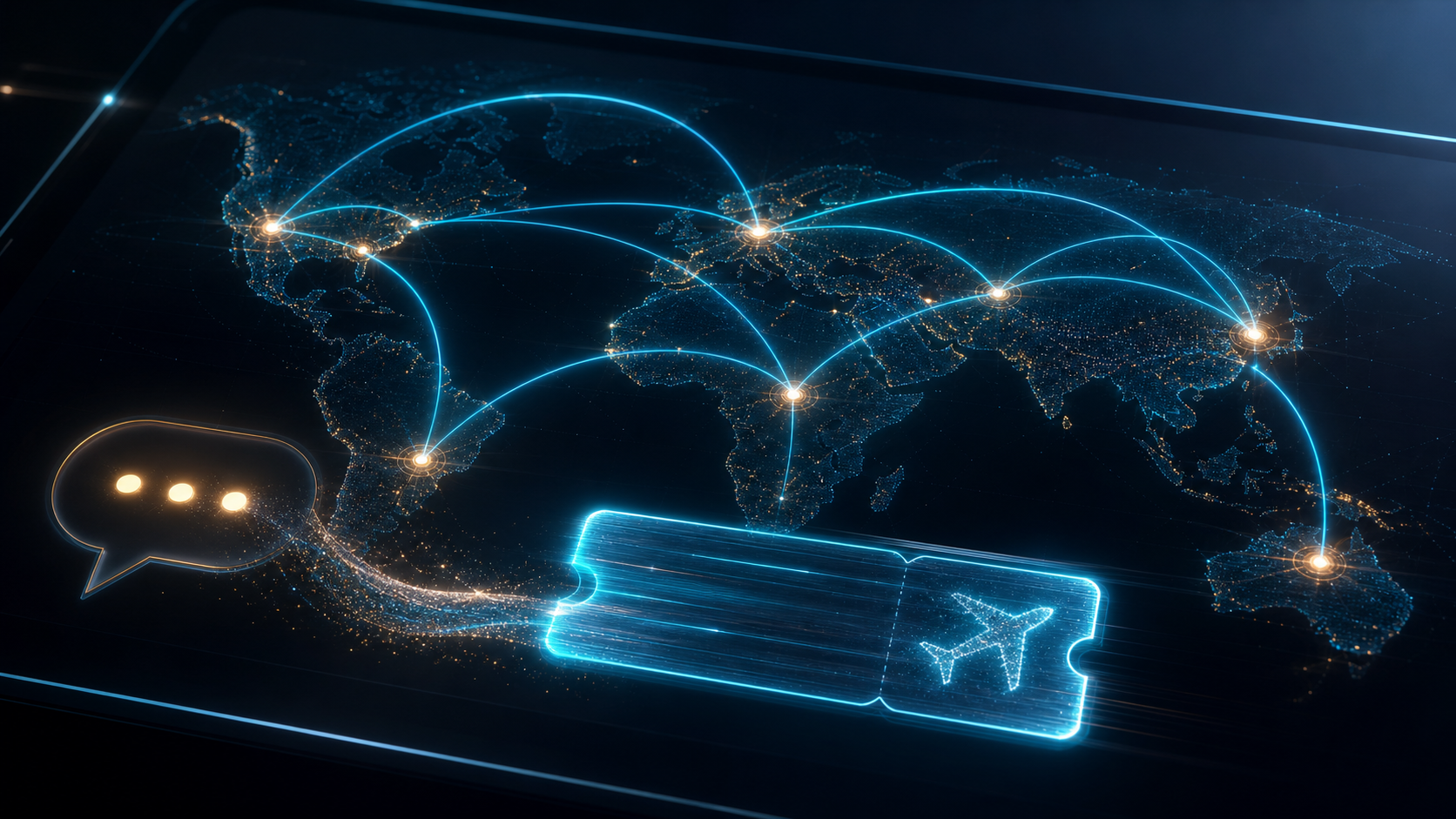
OpenAI published a case study on Omio, the multi-modal travel-booking platform, using OpenAI's models to power conversational travel experiences, accelerate product development, and — in OpenAI's words — transform into an AI-native company.
Why it matters. This is the same transformation playbook we keep seeing executed in the open: take an existing product loop and rebuild it around models, conversation first. For anyone selling into or sitting inside a product org, it is a useful template for what "AI-native" actually changes — and a reminder that the verb in these stories is rebuild, not add a chatbot.
Sources: openai.com/index/omio
Also on the radar
- Inference — DFlash speculative decoding: NVIDIA reports up to 15× faster inference on Blackwell for multi-turn, agentic workloads — the unglamorous speed layer that makes long agent sessions affordable.
- Browser ML — Moebius in the browser: Simon Willison used Claude Code to port the 0.2B Moebius image-inpainting model to run entirely in a web browser — a small model with outsized results, no server required.
- Agentic telecom — autonomous networks: NVIDIA walks through how telcos are moving from task-based automation to agentic AI that correlates and acts on its own across network operations.
- Open agents — CUGA apps: IBM Research shipped two dozen working agentic apps on a deliberately lightweight harness — real, runnable examples instead of one more framework.
Trends in dev tools
What moved in the tools engineers actually ship with.
- Coding agents are being engineered for the long haul. OpenAI's "Codex-maxxing for long-running work" walks through how Jason Liu keeps Codex working across complex, multi-session projects — preserving context so the work continues past a single prompt. The frontier in coding agents is shifting from one-shot answers to staying-power. (openai.com)
- Local models are doing real repo chores for free. Hugging Face got local models to triage the OpenClaw repo — labeling and routing PRs at no API cost. A reminder that not every agent task needs a frontier model or a bill. (huggingface.co)
- AI is moving into the release pipeline, human still in the loop. Hugging Face described shipping
huggingface_hubevery week with AI, open tools, and a human reviewer — agentic delivery applied to their own CI, not just a demo. (huggingface.co) - Prompt injection gets a sharper mental model. Simon Willison highlighted "Prompt Injection as Role Confusion" — research that reframes the attack as the model losing track of who is speaking, and (his favorite touch) ships a readable blog-style writeup alongside the paper. Useful framing for anyone hardening an agent. (simonwillison.net)
Popular skills
The agent-skills wave — portable folders of instructions an agent loads on demand — kept compounding this week.
- Skills are showing up in enterprise toolkits. NVIDIA's new BioNeMo Agent Toolkit hands an "AI scientist" agent a pack of domain skills and tools to run life-science discovery workflows — skills as packaged expertise an agent picks up for a specialized job.
- Vendors keep shipping official skills. Supabase ships agent skills you install with
npx skills add supabase/agent-skills, giving an agent safe database and security guidance instead of hoping it guesses right. (supabase.com) - One format, every agent. Anthropic's open Agent Skills format — portable
SKILL.mdfolders — now runs across Claude Code, Codex, Gemini CLI, Copilot, and Cursor, so a skill written once works in all of them.
AI fun fact
When you read "AI supercomputer," you are almost always reading "NVIDIA." On the June 2026 TOP500 list, NVIDIA technology powers over 400 of the world's 500 fastest supercomputers — 81% of the list, and 90% of the machines newly added this round. It runs the table on efficiency too: the entire top eight of the Green500 (the most energy-efficient supercomputers on Earth) run on NVIDIA GPUs. The AI boom has a single, very crowded bottleneck. (blogs.nvidia.com)
Sources: openai.com · openai.com · latent.space · blogs.nvidia.com · openai.com · huggingface.co · blogs.nvidia.com