Cold Open — GPT-5.6 Goes GA: Sol, Terra, and Luna Are Here
OpenAI moves GPT-5.6 to general availability as a three-tier family — Luna, Terra, Sol — and immediately deploys it as the preferred model in Microsoft 365 Copilot. Also: Codex converges with ChatGPT into a desktop superapp, and a builder ships a browser agent that reverse-engineers web apps into agent tools on the fly.

Thursday, July 10, 2026. We scanned 463 fresh items off the wire today; three made the cut — and the lead story is the kind of launch that reshapes how you route model calls.
Listen to today's episode on the Cold Open podcast page.
The lead · GPT-5.6 goes GA — Sol, Terra, and Luna are here
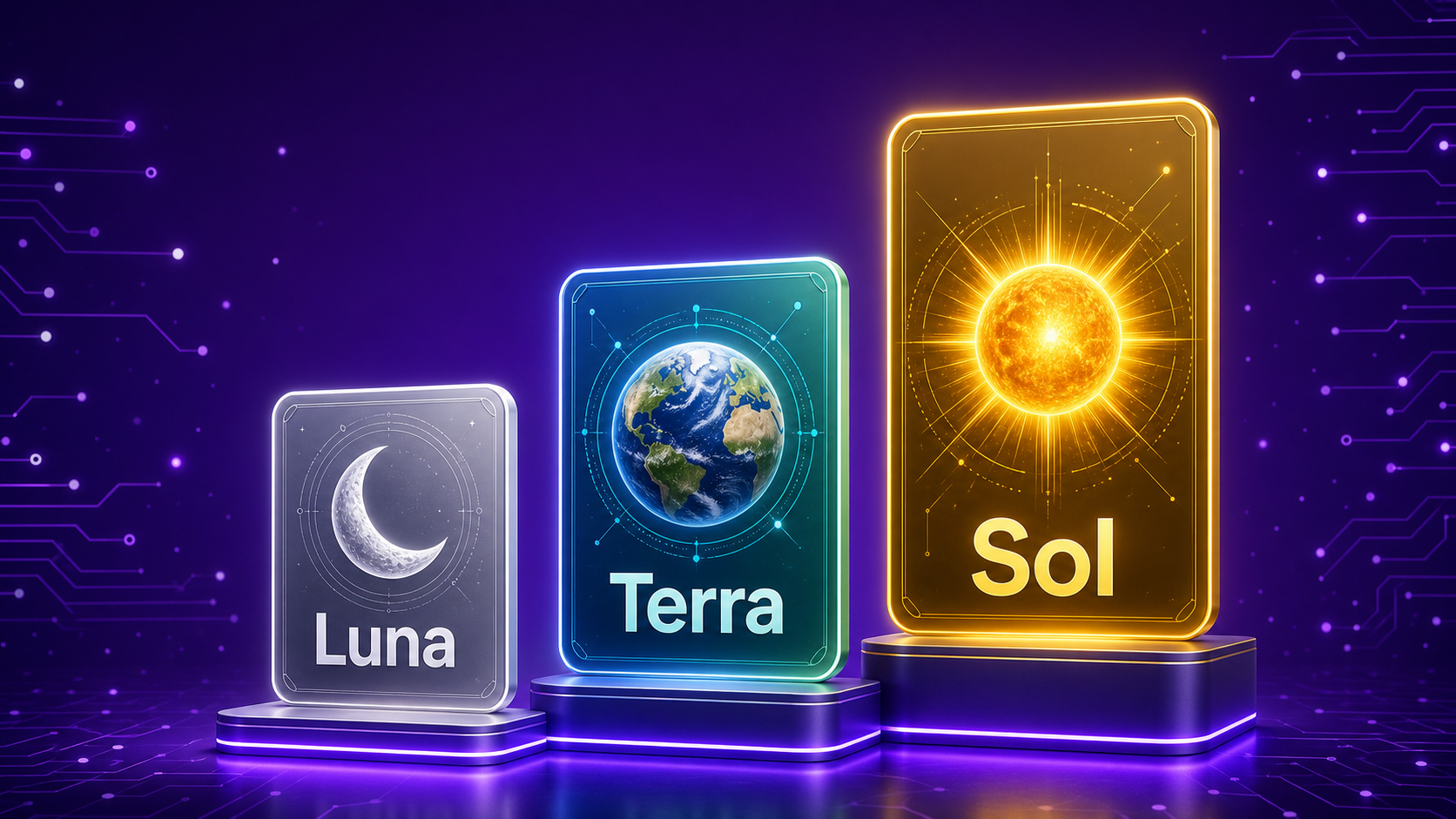
OpenAI moved GPT-5.6 to general availability on July 9, and it arrived not as a single model but as a named three-tier family. From smallest to largest: Luna (fast, cost-efficient), Terra (balanced), Sol (frontier). Simon Willison's coverage frames the structure cleanly: the names echo celestial bodies scaled by mass, which happen to mirror the capability–compute ladder the tiers are meant to represent.
"OpenAI's latest flagship model hit general availability this morning, and comes in three sizes: Luna, Terra, and Sol (from smallest to largest)." — Simon Willison, July 9, 2026
Microsoft 365 Copilot moved first. GPT-5.6 is now the preferred model across Word, Excel, PowerPoint, Chat, and Cowork — the fastest GA-to-enterprise rollout OpenAI has shipped at this tier.
Why it matters
The three-tier naming solves a routing problem that every builder with a cost-conscious pipeline has been solving by hand. Until now, picking a model meant choosing between named versions that implied capability differences without expressing them structurally. Luna/Terra/Sol maps a named capability ladder to a cost ladder — the model you want for a fast autocomplete pass is explicitly different from the one you use for an architectural review, and now the naming makes that distinction first-class.
This echoes the shift that happened in Codex CLI 0.144.1, where reasoning effort moved from discrete buttons to a continuous slider. The pattern is the same: give the user a named continuum, let them position per task.
The fine print
Three tiers mean three pricing points, three rate limits, and three places where your pipeline can encounter different latency or token limits. If you're building multi-step agentic flows, the routing decision is now yours to encode explicitly — the model won't choose its own tier. That's new operational surface for pipelines that previously just called one model name. Evaluate on your own tasks before locking in tier assignments.
Sources: simonwillison.net · openai.com/index/gpt-5-6-preferred-model-microsoft-365-copilot · latent.space
02 · Codex becomes the ChatGPT superapp

Latent Space's AINews read on the same launch day adds a separate story worth filing: the headline from the July 9 cycle isn't only the model — it's what Codex is becoming. Their coverage calls it Codex converging into the ChatGPT superapp: a single surface where chat, code agent, and background runs share context.
Simon Willison's July 10 follow-up adds the concrete detail: ChatGPT Work on desktop now surfaces local files and desktop apps directly, collapsing the gap between the agent environment and your actual working context. The CLI isn't going away, but the narrative context window is moving toward "everything open on your machine," not just the files you pass explicitly.
Why it matters. If you've been running Codex as a standalone CLI and treating the Chat and Codex products as separate surfaces, the product lines are converging. Prompts that today require file-passing boilerplate may soon run against your live desktop context with no additional setup. The implication for workflow builders: the scaffolding you wrote to hand context to Codex may become redundant before the year is out.
Sources: latent.space · simonwillison.net
03 · Reverse-engineering web apps into agent tools
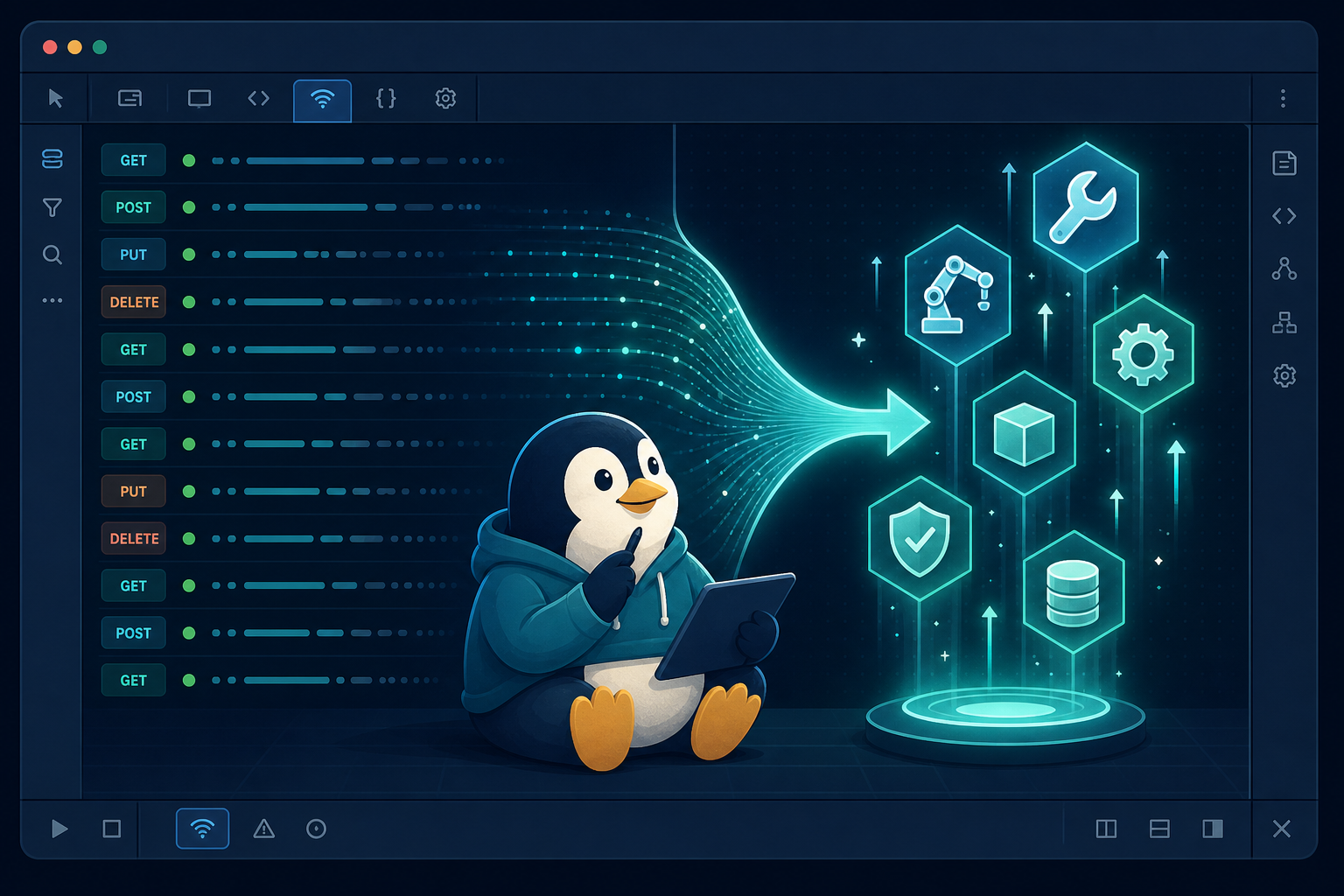
A Show HN post this week is a quiet signal worth noting: a builder shipped a browser-based agent that runs inside an authenticated web app, watches how the app calls its own backend APIs in real time, and automatically turns those observed calls into replayable agent tools — effectively auto-generating a tool spec from live network traffic. No manual reverse-engineering, no HAR-export ritual.
Why it matters. This is the automation of a pattern that builders running browser-sniff discovery today do by hand. Compressing it to a zero-config in-session wrapper closes the distance between "web app with no public API" and "agent-callable service." For anyone building workflows on top of enterprise tools that don't publish an OpenAPI spec, this approach — or something like it — is the path of least resistance. Watch this space.
Source: news.ycombinator.com/item?id=48847834
Also on the radar
- Coding agent benchmarks — DeepSWE: 113 original, long-horizon software engineering tasks for evaluating frontier coding agents — tasks that look like real PRs, not toy problems.
- Multi-agent debugging — Who Broke the System?: new paper on failure localization in LLM-based multi-agent systems — a practical tool for the moment when six agents are running and one is the culprit.
- Data science agents — CausalDS: benchmarking causal reasoning in data-science agents, because running the regression is no longer the hard part.
- CUDA inference — Kernel Fusion in NVIDIA CUDA: the low-level optimization guide for anyone stacking inference workloads on constrained hardware.
Trends in dev tools
Four real items from today's radar.
- Model routing is now a first-class product decision. GPT-5.6's Sol/Terra/Luna naming makes explicit what was always implicit in production pipelines: different task types justify different inference costs. Codex CLI 0.144.1 already exposes this via a reasoning-effort slider at the session level. The next step is per-call tier routing inside agent orchestration layers — expect every major SDK to add native tier-selection primitives in the next release cycle.
- DeepSWE sets a new bar for coding-agent evals. 113 long-horizon, original software engineering tasks — not reprocessed open-source issues — give evaluators a test set that maps to real backlog conditions. If your coding agent can't close a DeepSWE ticket, it's not ready for your production codebase. (arxiv.org/abs/2607.07946)
- NVIDIA BioNeMo Agent Toolkit ships for co-folding. NVIDIA published an accelerated co-folding pipeline using the BioNeMo Agent Toolkit — early signal that agent orchestration patterns are landing in scientific compute, not just software development. The architectural shapes are the same; the domain-specific constraints are different. (developer.nvidia.com)
- Hardware-friendly LLM design is a discipline now. NVIDIA's model co-design post covers how architecture choices cascade into hardware efficiency at inference time. A read worth flagging if you're evaluating new base models for fine-tuning or deploying on constrained infrastructure. (developer.nvidia.com)
Popular skills
The agent-skills wave — portable skill folders that coding agents load on demand — keeps finding new use cases.
- Codex superapp integration means skills travel further. As ChatGPT Work and Codex converge into a single desktop surface with file and app access, skills authored for Codex CLI run inside a richer ambient context. The gap between "skill installed" and "skill has what it needs to run" is shrinking — skills that previously required manual file-passing may soon invoke against your live workspace state.
- CausalDS points to skills as evaluation harnesses. The paper's framing — agents that combine causal reasoning with data-science workflows — is the pattern where a skill encodes domain procedure and the agent executes it, not just data retrieval. Evaluation skills are the next frontier after task-execution skills. (arxiv.org/abs/2607.08093)
- MAVEN formalizes multi-stage agentic annotation. The MAVEN pipeline uses a structured agentic sequence for video reasoning annotation — a skill-shaped workflow for generating high-quality VLM training labels at scale. The skill encodes the annotation procedure; the agent runs it. (arxiv.org/abs/2605.21917)
AI fun fact
The names Luna, Terra, and Sol for GPT-5.6's three tiers follow the same progression as the International Astronomical Union's naming conventions for the three most familiar bodies in our solar system — the Moon, Earth, and Sun — each roughly 150× further from Earth than the last, and each roughly an order of magnitude larger. The model tiers follow a similar capacity scaling. OpenAI is not the first lab to use celestial naming: Mistral has Stella and Codestral, Anthropic uses character-arc names (Haiku, Sonnet, Opus). But Sol/Terra/Luna is the first family where the names encode a physical mass hierarchy that mirrors the capability stack. Whether intentional or coincidental, it's a cleaner mnemonic than sequential version numbers. (openai.com · simonwillison.net)
Sources: simonwillison.net · openai.com · latent.space · simonwillison.net (Jul 10) · news.ycombinator.com · arxiv.org/2607.07946 · arxiv.org/2607.07989 · developer.nvidia.com