Cold Open — Fable Stays. The Frontier War Landed in Your Subscription.
Anthropic extends Claude Fable access on Max plans — again — because GPT-5.6 Sol just matched the frontier. Also: real production numbers on migrating to GPT-5.6 (2.2× faster, 27% cheaper), and a new multi-agent orchestration paper that replaces fixed routing with auctions.

Sunday, July 13, 2026. We scanned 2,565 items across 21 sources; three made the cut — and the lead is a story about competitive pressure so intense it literally changed what your AI subscription gives you.
Listen to today's episode on the Cold Open podcast page.
The lead · Fable gets another bump — the frontier war landed in your Max plan

Anthropic quietly extended the date that Claude Fable stops being available on Claude Max plans. Simon Willison noticed the bump and named the reason plainly: GPT-5.6 Sol is a Fable-class model, and Anthropic responded by keeping Fable in the hands of Max subscribers longer than originally planned. This is the second extension of this kind — "once again," in Simon's framing.
The Anthropic team confirmed via X:
"We're extending Claude Fable's availability in Claude Max plans…"
The full announcement details the new end-date for Fable access on the Max subscription tier.
Why it matters
Read this as a real-time competitive signal, not a routine product update. When one lab ships a model that matches another lab's flagship, the matching lab's response is to keep the flagship accessible — not to push subscribers down a tier. For builders who run long agentic sessions on Max: the ceiling keeps rising as an emergent outcome of the model war itself.
There is also a second-order effect worth internalizing. Anthropic's pattern of extending Fable access confirms that the frontier is compressing. A model released as a premium tier one quarter becomes the baseline the next. If you are designing pipelines that assume today's performance ceiling, plan for headroom — the ceiling will move before your architecture does.
The fine print
"Extended" doesn't mean "permanent." When Anthropic eventually does phase Fable out of Max — and they will — the runway will be real but finite. Keep tabs on the end-date announcement. And if you are building on Fable-specific behaviors (long problem-solving chains, complex multi-step reasoning), start documenting which behaviors are load-bearing now, so migration to whatever comes next is scoped work, not archaeology.
Sources: simonwillison.net · @claudeai on X
02 · Moving a production agent to GPT-5.6: 2.2× faster, 27% cheaper
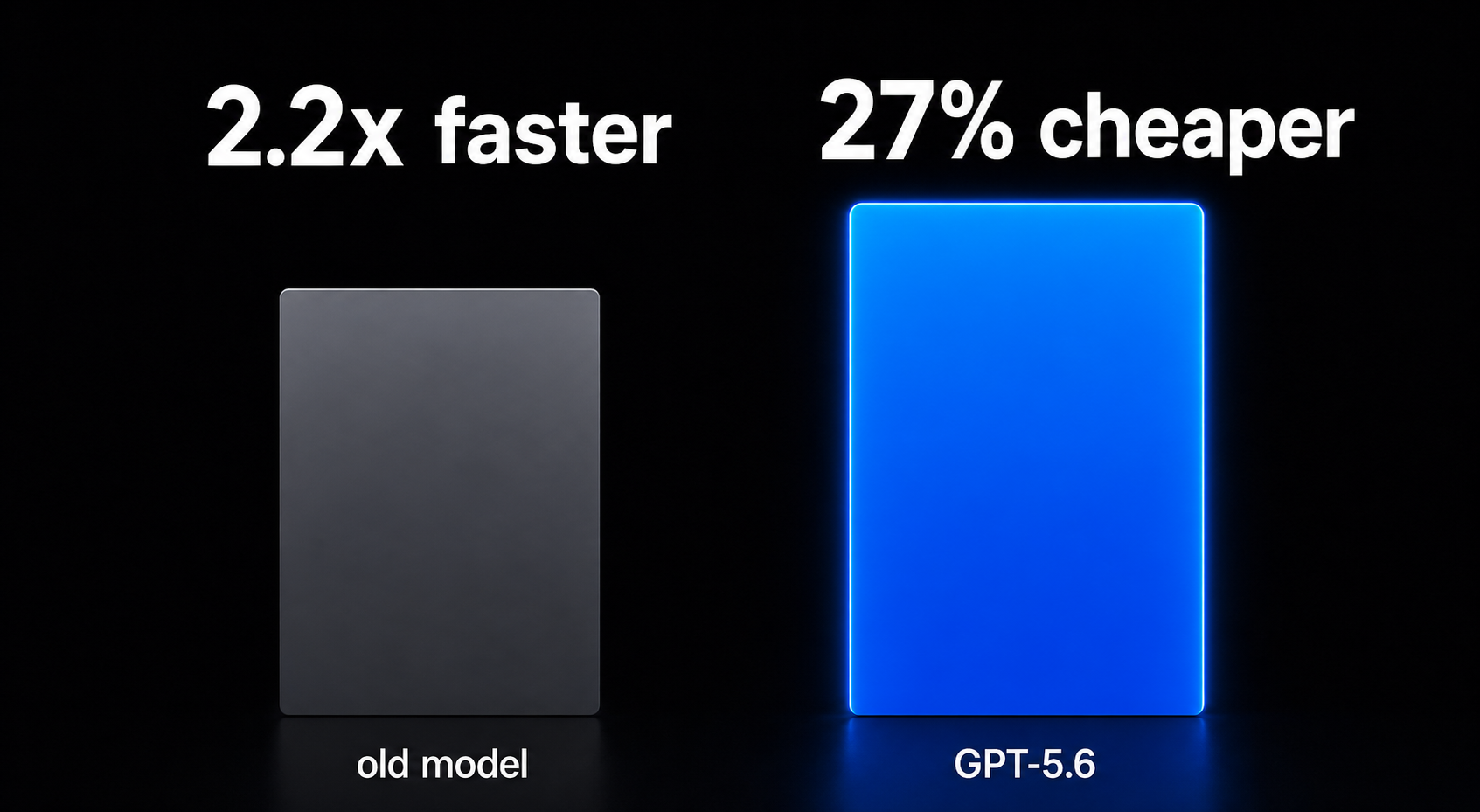
The team at ploy.ai published a real production migration: they moved a live AI agent from their previous model to GPT-5.6 and measured what changed. The headline numbers: 2.2× faster, 27% cheaper. Same production workload, concrete observed results.
Why it matters. Model migration decisions are usually made on benchmark intuition or cost-per-token math done in a spreadsheet. This is observed production data with both speed and cost moving in the same direction — faster and cheaper simultaneously, which is not the typical trade-off. For anyone sitting on a multi-model routing decision right now, this is a data point worth reading carefully before you commit to a tier assignment on the Sol/Terra/Luna family.
Sources: ploy.ai/blog/migrating-a-production-ai-agent-to-gpt-5-6 · HN discussion
03 · Agora: agents that bid for tasks, not just receive them

A paper out of arXiv this week proposes Agora, a multi-agent orchestration framework where tasks are allocated via auction-based bidding rather than fixed routing rules. The core problem it addresses: most agent frameworks today route tasks based on predefined rules or static patterns, which means the routing is as smart as the person who wrote the rule — and no smarter.
In Agora's model, each expert agent submits a confidence-weighted bid for a given task. The orchestrator allocates based on bids, not rules. The effect: agent systems can dynamically specialize based on what they are actually good at for the incoming request, not what the framework pre-categorized them as.
Why it matters. This is research, not shipped code — but it points at a real friction builders hit when assembling agent teams: the routing layer is usually the dumbest part of the system. Auction-based allocation is a concrete mechanism for making routing itself adaptive. Watch for this pattern showing up in frameworks like CrewAI, AutoGen, and Claude's own multi-agent tooling in the months ahead.
Sources: arxiv.org/abs/2607.09600
Also on the radar
- Content labeling debate — A Hacker News thread asks whether HN should add a flag for AI-generated articles. Not a policy yet, but the question is being asked loudly — builders are starting to feel the signal-to-noise pressure.
- Edge attention gets efficient — STEEL (arXiv:2607.09385) proposes sparsity-aware fused attention for long-sequence inference on AMD's XDNA NPU — laptop-class AI chips getting their own optimization path, not hand-me-down GPU tricks.
- DRI for AI accountability — Simon Willison surfaced the GitLab handbook's "Directly Responsible Individuals" model. If you're building agent teams, the question of who owns an agent's output is not hypothetical. The DRI pattern is one answer.
- sqlite-utils 4.1.1 — A minor release where a regular Claude chat session spotted the edge-case being fixed. The toolchain is eating its own cooking.
Trends in dev tools
What moved this week in the tools engineers actually ship with.
- Edge inference gets its own optimization layer. STEEL (arXiv:2607.09385) introduces sparsity-aware attention fused specifically for AMD's XDNA NPU — the class of hardware in modern AI-equipped laptops. The key insight: attention is naturally sparse, and GPU-first frameworks don't exploit that. NPU-native attention can cut energy use for long-sequence agents by a meaningful margin. If you're thinking about on-device agentic workloads, the hardware path is maturing faster than the software.
- Agent orchestration is becoming a formal discipline. Agora (arXiv:2607.09600) is the latest in a string of papers treating multi-agent task routing as a system design problem with measurable solutions — not a prompt-engineering problem. The auction primitive is concrete and testable. Expect framework-level implementations within the next few releases of the major agentic orchestration libraries.
- Vision-Language Models on edge: the cost is in the words, not the pixels. Research (arXiv:2607.09520) found that on edge hardware, the image encoder of a VLM uses far less energy than the text decoder. Looking at an image is nearly free. Generating a response token-by-token is where the battery goes. This has direct implications for how you design prompts in multimodal edge agents: fewer words out, not fewer pixels in.
Popular skills
The agent-skills wave — portable instruction folders coding agents load on demand — kept expanding into harder technical domains this week.
- Quantum hardware is next. QAgent (arXiv:2508.20134) proposes a multi-agent system for autonomous OpenQASM programming — quantum circuit assembly at the hardware-aware level. If agent skills can reach quantum circuit optimization, the technical domain ceiling for skills-as-encapsulated-expertise is effectively gone.
- Security agents with structured playbooks. VEXAIoT (arXiv) presents autonomous IoT vulnerability exploitation using AI agents — structured pen-test workflows encoded as agent skills that can run against IoT device classes. The pattern: encapsulate domain expertise (penetration testing methodology) into a skill an agent loads per engagement.
- Confidence-based routing as a skill primitive. The Agora paper's core contribution is also a skill-design insight: agents should express how confident they are about handling a task, not just whether they can. If you design skills that return confidence scores alongside results, an orchestrating layer can do smarter routing without needing to know what the skill does.
AI fun fact
Vision-Language Models running on edge hardware spend most of their energy on words, not pictures. A paper this week (arXiv:2607.09520) found that the image encoder — the part that processes the photo — consumes less than 20% of total inference energy on laptop-class hardware. The text decoder, generating the response token by token, accounts for the rest. The researchers' own title captures it best: "Seeing is Free, Speaking is Not." If you're building multimodal AI for power-constrained devices, the optimization target is the decoder, not the vision stack.
Source: arxiv.org/abs/2607.09520
Sources: simonwillison.net — Fable bump · x.com/claudeai · ploy.ai GPT-5.6 migration · HN #48882716 · Agora arXiv:2607.09600 · STEEL arXiv:2607.09385 · Edge VLM arXiv:2607.09520 · QAgent arXiv:2508.20134